
Advisors Corner
Professor David Murhammer
Greetings to Hawkeye Chemical Engineers!! Two major events, i.e., the 100-year anniversary of the Chemical Engineering program at the University of Iowa and the 2026 AIChE Mid-America Regional Student Conference, were held in our department during the Spring 2026 semester. This issue of our AIChE Student Chapter Newsletter contains an article about the 100-year celebration and three articles about the regional student conference. The AIChE Mid-America region contains 14 chemical engineering programs; students and some advisors from 12 of these programs attended the conference. The University of Iowa team won the ChemE Car poster and ChemE Jeopardy competitions (see related articles in this newsletter). This is the 9th consecutive year that the University of Iowa’s ChemE Jeopardy team has won the regional competition. This current streak began in 2018 when the team of Megan Jones, Zachary Kazmer, Madison Murhammer, and Elizabeth Zimmerson won the regional competition hosted by Oklahoma State University.
Other articles in this newsletter include an overview of our K-12 volunteering events and the Tinker Safety Prize competition.
Finally, I would like to inform readers of this newsletter that I will be retiring at the end of the 2026-2027 academic year and that another faculty member will be taking over my role as AIChE Student Chapter advisor.
Any comments about the newsletter should be sent to me at david-murhammer@uiowa.edu.
UIowa ChemE Car: Winning the Regional Poster Competition
By Spencer Dove
For this year’s ChemE Car competition, a team of students set out to build something unconventional: a car powered by a nitinol engine. The project, named NiTires after the nickel (Ni) and titanium (Ti) alloy used in the design, explored how shape-memory metals can transform thermal energy into mechanical motion.
The team consisted of Cielo Paz, Spencer Dove, Camylle Fay, Jakelyn Leycock, Mari Ades, and Addison Donovan. Together, the group spent months designing, testing, troubleshooting, and rebuilding nearly every part of the project.
At the center of the car was nitinol, a unique shape-memory alloy capable of “remembering” a trained shape. The wire was first trained to remain straight before being welded into a continuous loop. When exposed to heat, the wire attempted to return to its original shape, producing a pulling force that turned a pulley system and powered the car forward.
One of the biggest challenges came from working with the nitinol wire itself. Traditional welding methods could not properly join the material, forcing the team to search for a specialized laser welding solution. Even after overcoming fabrication issues, the final wire configuration could not generate enough force to move the full weight of the car.
“The hardest part was realizing that being an engineer means failing a lot,” said Spencer Dove. “The important thing is learning how to adjust, redesign, rebuild, and test again. It was far more work than I expected, but also far more rewarding.”
For many team members, the project became an introduction to real engineering design work.
“The whole process had to be designed by ourselves,” said Camylle Fay. “Learning how to develop everything from scratch was both interesting and insightful.”
Despite extensive testing and redesigning, the vehicle ultimately could not complete a successful run during the competition. However, the team refused to let that define the project. Instead, they focused on presenting the engineering process, innovation, and lessons learned throughout development.
“This project had a lot of ups and downs,” said Cielo Paz. “As team captain, I had to help lead the engineering process while also keeping the team motivated and believing in what we were building. In the end, everyone’s hard work paid off.”

Although the team did not compete in the final ChemE Car race, their persistence and presentation earned them first place in the AIChE ChemE Car Poster Competition. More importantly, the experience showed the group that engineering is not about getting something perfect on the first attempt, but about learning from failures and continuing to improve through each redesign
2026 AIChE Regional Conference Hosted By the University of Iowa
By Ria Patel
Overview
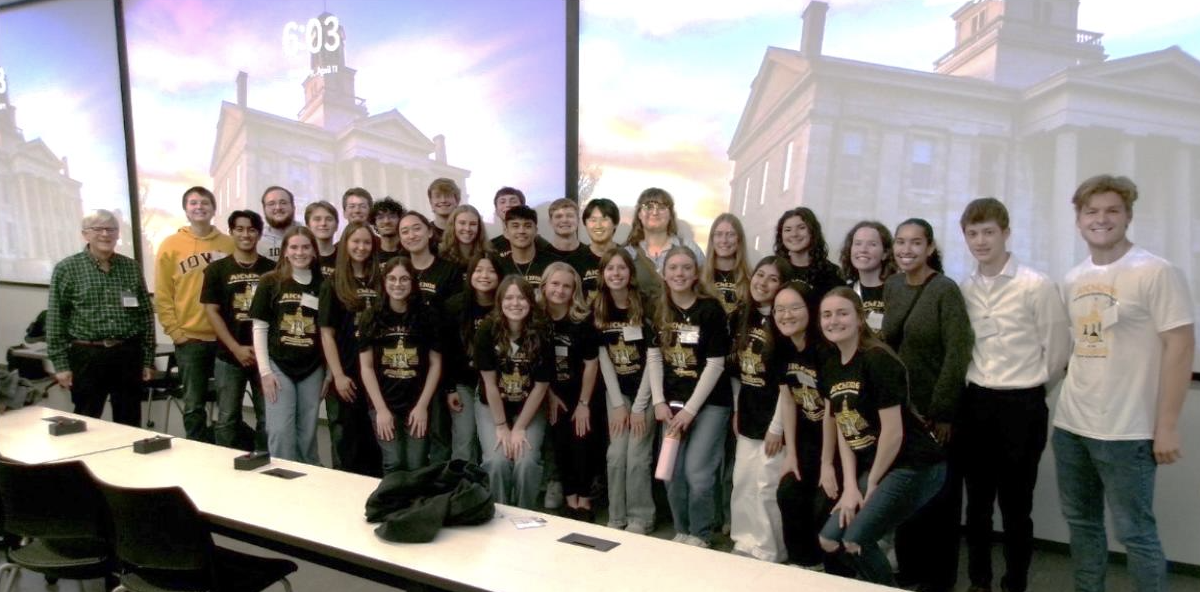
The University of Iowa had the pleasure of hosting the 2026 AIChE Mid-America Regional Student Conference on April 10 and 11. The conference, organized by students Don Roberts and Ria Patel, brought together over 200 students and faculty from 12 different universities for a weekend of competitions, presentations, and networking events.
The weekend began on Friday night with a social mixer organized by Natalie Schlichte, giving students and faculty the opportunity to connect before Saturday’s conference events.
ChemE Car
The ChemE Car competition was hosted at the Iowa Memorial Union and organized by incoming seniors Cade Machin and Ashley Constantino. This competition challenges student teams to design and build a small chemically powered car that must travel a specific distance. Safety checks and poster judging took place Friday night, followed by the performance competition on Saturday morning, April 11. Eight teams participated in the poster competition, and seven teams competed in the performance competition.
The University of Iowa’s “NiTires” took first place in the poster competition. Second place went to the University of Missouri’s “The Shelldon,” and third place went to the University of Arkansas’ “Hoggenheimer.”
In the performance competition, the University of Kansas took first place with “The Jay Wagon.”
Student Technical Presentations
The Student Technical Presentations give students the opportunity to formally present their research to judges in both academic and technical/industry-related fields. These presentations were held throughout the day on April 11 in the Seamans Center. It was organized by recent graduate Klaertje Hesselink and included 14 student presenters. One of the presenters was University of Iowa student Rhea Fisch, who presented her research titled “Development of Polyhydroxyalkanoate Engineering Tools Through Analysis of Cupriavidus necator Wild Type Biodiversity.”
First place was awarded to Jacob McCormick from the University of Tulsa. Second and third place were awarded to University of Arkansas students Olivia Reid and Lilly Hutchinson, respectively.
Student Poster Competition
The Student Poster Competition was held on Saturday afternoon in the Seamans Center and was organized by recent graduate TJ Kimm. This competition allows students to present their research visually and discuss their work with judges and attendees. 19 students participated, including University of Iowa student Alex Quast, who presented his poster titled “Lithium Uptake by Hydrogen Manganese Oxide: Influence of Particle Size and Solution Properties on Performance.”
First place was awarded to Nora Jennings from the University of Kansas. Second place went to Shomoy Kamal from the University of Tulsa, and third place went to Nour Bou Alan from the University of Oklahoma.
ChemE Jeopardy
ChemE Jeopardy took place Saturday afternoon in the Seamans Center and was organized by Gabi Fiedor and Shourya Singh. 14 teams competed in a Jeopardy-style competition with questions covering chemical engineering and pop culture categories. The University of Iowa had three teams participate: “Competitively Inhibited,” “Nu-Tang Clan,” and “Fugacity Fighters.”
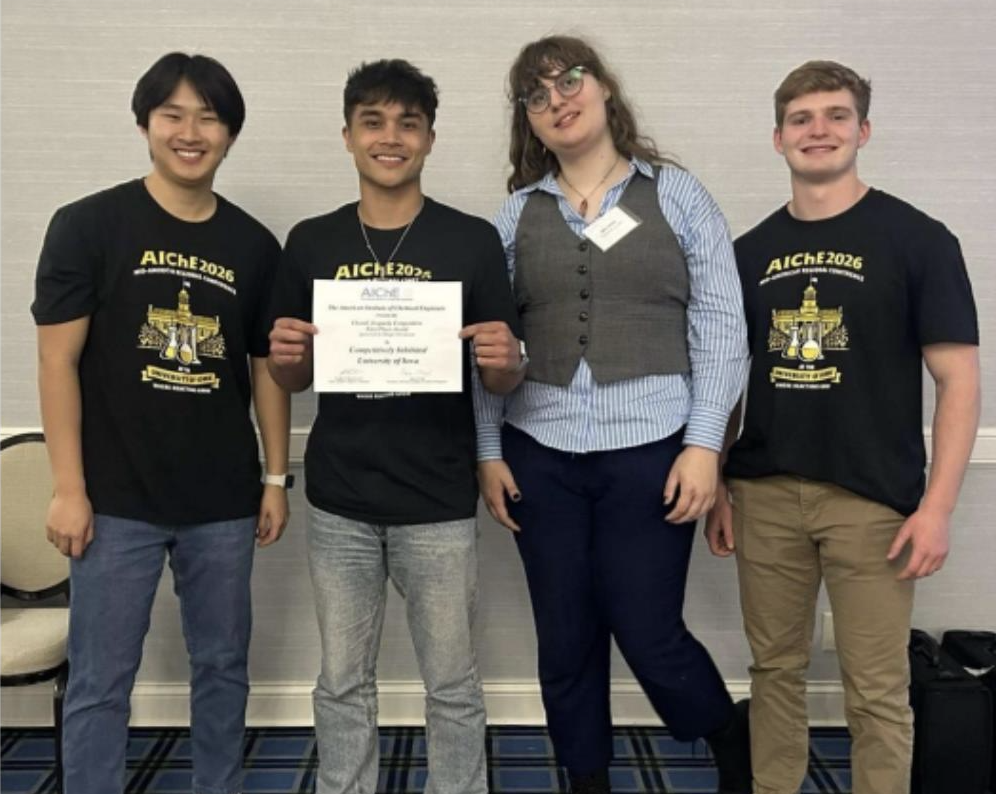
The University of Iowa’s “Competitively Inhibited” team took first place. The team members were Rhea Fisch, Eric Hou, Don Roberts, and Cade Machin. Second place went to Iowa State’s “ISU Cardinal”, and third place went to the University of Iowa’s “Nu-Tang Clan.”
Awards Banquet
The conference concluded with an Awards Banquet at the Graduate Hotel for students, faculty, volunteers, and professors from the participating schools. The banquet was organized by Evelyn Moorhouse and Isabelle Pfieffer and provided an opportunity to recognize the weekend’s competition winners and celebrate the conference’s success. Distinguished alumna Dr. Lilia A. Abron gave an inspiring keynote address about “compassionate engineering.” Linda the Comedic Hypnotist provided entertainment to conclude the regional conference.
Conclusion
Overall, the 2026 AIChE Mid-American Regional Conference was a successful and memorable weekend for everyone involved. The conference brought together students and faculty from across the region for technical presentations, research posters, ChemE Car, ChemE Jeopardy, and networking events. Strong participation from visiting schools, University of Iowa students, and organizers helped make the weekend run smoothly and highlighted the strength of the chemical engineering community. Hosting this conference would not have been possible without the support of the Department of Chemical and Biochemical Engineering, as well as our AIChE Student chapter and the many other students and faculty who contributed their time and effort. Furthermore, financial support was provided by Omega Chi Epsilon, AIChE ChESS (Chemical Engineering Supporting Students), Cambrex, cGMP Consulting, Emerson, FM, Ingredion, Lesaffre, Proctor & Gamble, and International Paper. The University of Kansas will host the 2027 regional conference.
ChemE Jeopardy Success
By Cade Machin
A marquee event of the 2026 AIChE Mid America Regional Conference was the ChemE Jeopardy competition. Twelve students on three teams from the University of Iowa competed: Competitively Inhibited (Rhea Fisch, Eric Hou, Cade Machin & Donny Roberts), the Nu Tang Clan (Grant Anderson, Henry Benton, Jake Loos & Fahim Rafi), and the Fugacity Fighters (Matt Kawa, Luke Miller, Alex Rohm & Lauren Triggs). Each team from the University of Iowa advanced to the second round, and the Nu Tang Clan and Competitive Inhibited advanced to the final round. Competitively Inhibited took home first place, and Nu Tang Clan finished third place.
Competitively Inhibited dominated throughout the competition, building such a strong lead that the team wagered $0 during each Final Jeopardy round. The team hopes to carry this momentum into Fall 2026 AIChE National Meeting, where they will compete for a national title. More broadly, the outstanding performance of the University of Iowa teams reflected the commitment and preparation of all participating students, who dedicated time to weekly practices leading to the event.
The success of both the weekly practices and the competition itself was made possible by planning co-chairs Gabi Fiedor and Shourya Singh along with several volunteer emcees, scorekeepers, and timekeepers. With the University of Iowa hosting this year’s regional conference, the strong participation of students beyond Jeopardy competitors made the event especially meaningful. Their involvement highlighted the dedication, collaboration, and talent within the University of Iowa chemical engineering program.
K-12 Volunteering Events
By Holly Shriber
This semester, the K-12 Outreach Program had the opportunity to visit a fourth-grade classroom at Coralville Central and three kindergarten classrooms at Weber Elementary. This was our first year working with the kindergarten classrooms, and we were excited to introduce them to hands-on science activities. Nine University of Iowa chemical engineering students volunteered to help teach during the visit.
For the kindergarten classes, we taught students about exothermic reactions by discussing the process of making sidewalk chalk. The students received pre-made sidewalk chalk and take-home instructions so they could continue exploring and learning outside of the classroom. During the in-class discussion the students appeared interested and were engaged. They asked many enthusiastic questions, including, “Can we eat the chalk?” We made sure they knew the chalk was only for drawing, although they seemed far less bothered about it.
During our visit with the fourth-grade class, we demonstrated several types of separation techniques, including physical separation, separation based on buoyancy differences, and liquid chromatography. After each activity, we had a class discussion to explain the science behind the experiment. We also asked students to think like engineers by considering how the separations could be made faster or scaled up for larger quantities. We ended the visit by discussing how chemical engineers use these same types of techniques to separate desired products from unwanted materials in real-world processes.
Next fall, we will return to both the kindergarten and fourth-grade classrooms. We will be joined by the newest member of the AIChE K-12 Outreach Program, Katherine Crome. Katie will bring new ideas to the program and will join us in Minneapolis for the Annual AIChE Conference. The K-12 Outreach Program is a valuable opportunity for young students excited about science and introduces them to chemical engineering, while also allowing chemical engineering students to strengthen their presentation and communication skills with a young audience.
Tinker Safety Prize
By Henry Benton
The Tinker Safety Prize Competition is one of the most unique and impactful extracurricular opportunities offered not only at Iowa but across chemical engineering programs nationwide. Established seven years ago by distinguished alumna Sharon Tinker, a longtime engineer at ExxonMobil, the competition was created to strengthen student engagement with chemical process safety. The competition challenges students to deepen their understanding of process safety through the investigation of real industrial incidents. Participants select and analyze a U.S. Chemical Safety Board (CSB) incident report, summarize their findings in a written paper, and present their work in the form of a research poster. Essays are first evaluated by a panel of alumni and former participants, followed by poster presentations before the judges. The first-place winner received a $1,000 prize, while two runners-up were awarded $500 each, and all other participants received $100.
This year, six chemical engineering juniors participated in the competition, a 50% increase from last year's competition, particularly impressive considering the much smaller class size this year. Participants signed up at the end of the fall semester and completed the report summary over winter break. Posters were due on the day of presentations: Friday, February 20th. Participants presented their posters to each judge individually, along with answering questions and accepting valuable feedback. After every poster had been evaluated, the judges reconvened and determined the winners: Henry Benton (1st place), Cade Machin (runner-up), and Lauren Triggs (runner-up).
For my CSB report, I chose the 2010 Tesoro Refining and Marketing Company refinery incident in Anacortes, Washington, titled Catastrophic Heat Exchanger Rupture and Fire. The incident centered on a catastrophic rupture in the refinery’s Naphtha Hydrotreater (NHT) unit, where a heat exchanger failed during startup operations, releasing a large quantity of flammable hydrogen and hydrocarbon vapor that ignited and ultimately claimed the lives of seven workers. What initially drew me to the incident was the scale of the tragedy, but as I continued my research, I became increasingly interested in the technical and organizational failures that contributed to the disaster.
Through my analysis, I explored both the engineering and process safety aspects of the incident, including equipment degradation, refinery operations, and failures in mechanical integrity and hazard recognition. One of the most valuable parts of the competition was the opportunity to take an incredibly complex industrial event and translate it into a clear, concise technical story through both a written report and a poster presentation. The experience challenged me to think critically about how chemical engineers identify, communicate, and ultimately prevent major process safety hazards.
As engineering students, we often gravitate toward quantitative solutions. Chemical process safety, however, depends just as much on collaboration, communication, and sound engineering judgment. It is impossible to fully quantify the process safety culture of a plant; rather, it requires understanding how layers of safety control function, how effective they are, and how they work together to prevent catastrophic failures. The 2010 Tesoro Anacortes incident reinforced an important lesson for me: calculations alone could not have saved the lives of the seven workers lost that day. A strong process safety culture, supported by an effective process safety management system, would have prevented the tragedy from occurring in the first place.
Participating in the Tinker Safety Prize Competition proved to be an incredibly valuable experience, challenging me to think beyond technical calculations and consider the broader responsibilities engineers hold in protecting workers and communities. I would strongly encourage next year’s cohort of junior chemical engineering students to participate.
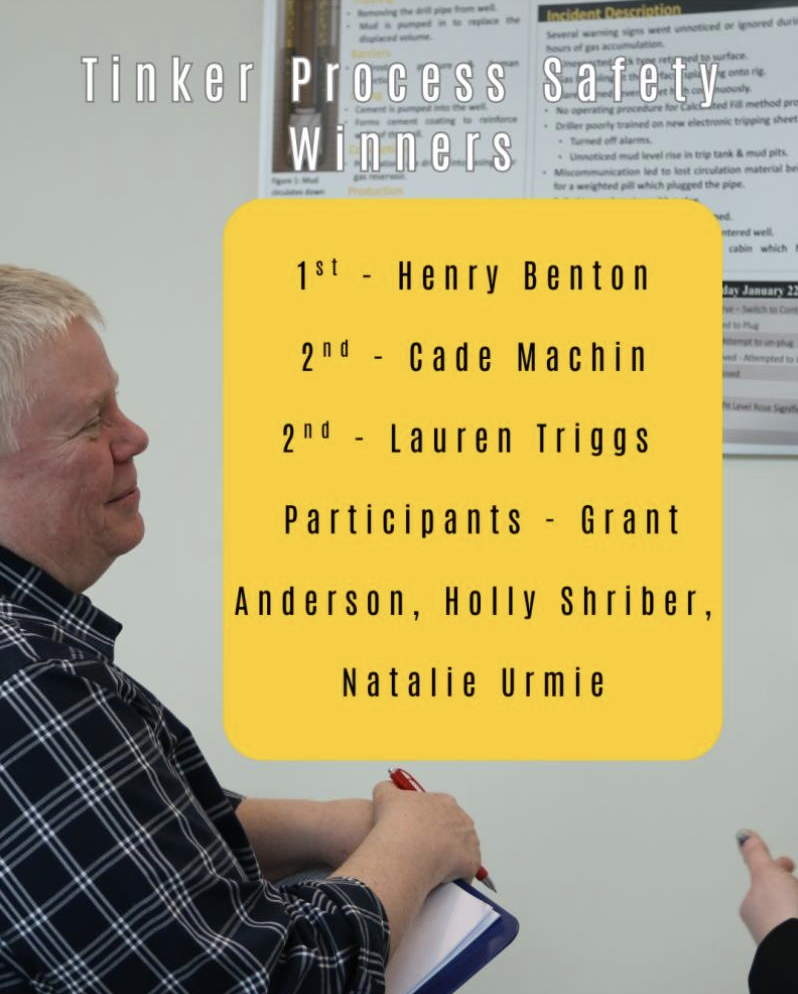
Sharon Tinker, sponsor of the Tinker Process Safety Prize Competition
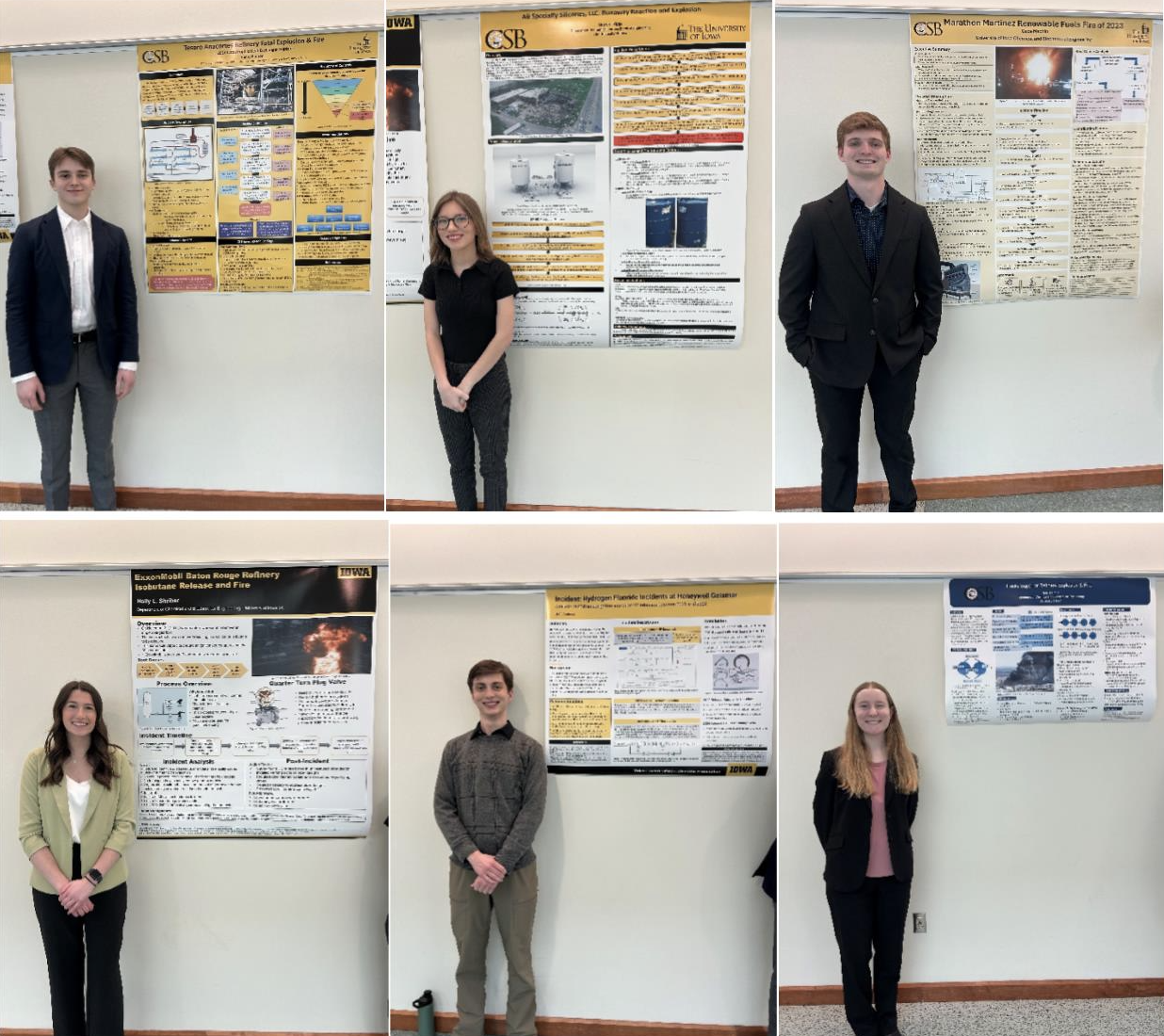
2026 Participants in the Tinker Process Safety Prize Competition (clockwise beginning in the upper left corner): Henry Benton, Lauren Triggs, Cade Machin, Natalie Urmie, Grant Anderson, and Holly Schriber.
Iowa CBE Department 100th Anniversary Celebration
By Henry Benton & Matt Kawa
It feels like only a short time ago that we were incoming freshmen being introduced to the Chemical and Biochemical Engineering Department, when Dr. Jun Wang casually mentioned that the department would celebrate its 100th anniversary during our time at Iowa. At the time, the milestone felt far away. Yet, before we knew it, the centennial celebration had arrived, offering students, alumni, and faculty an opportunity to reflect on the department’s profound impact, not only on the students it has educated, but also on the many ways those students have gone on to shape the world.
The celebration officially began on Wednesday, April 8, with the opening of historical displays in the Lichtenberger Engineering Library. Featuring photographs, memorabilia, and artifacts dating back to the department’s earliest years, the exhibit highlighted a century of innovation, research, and student achievement. Later that evening, members of the CBE Advisory Board, faculty, students, and alumni gathered for a happy hour at Reunion Brewery, kicking off the week’s celebration with conversation and reconnection.
On Thursday, April 9, the department hosted the Carmichael Symposium in the IMU Richey Ballroom. The symposium celebrated the remarkable legacy of Dr. Greg Carmichael, a University of Iowa professor for nearly 50 years and internationally recognized leader in atmospheric science and air pollution research. Throughout the day, alumni, collaborators, and leading researchers from around the world shared presentations on air quality, environmental science, and the lasting impact of Dr. Carmichael’s work. Another highlight of the four-day celebration was the milestone banquet. Students, alumni, faculty, and distinguished guests gathered in the IMU International Ballroom to share a meal, reconnect, and celebrate the department’s achievements. The evening featured excellent food, lively conversation, and dancing, culminating in a keynote address from distinguished alumna Dr. Lilia A. Abron, who emphasized the importance of using engineering to improve lives and address challenges around the world.
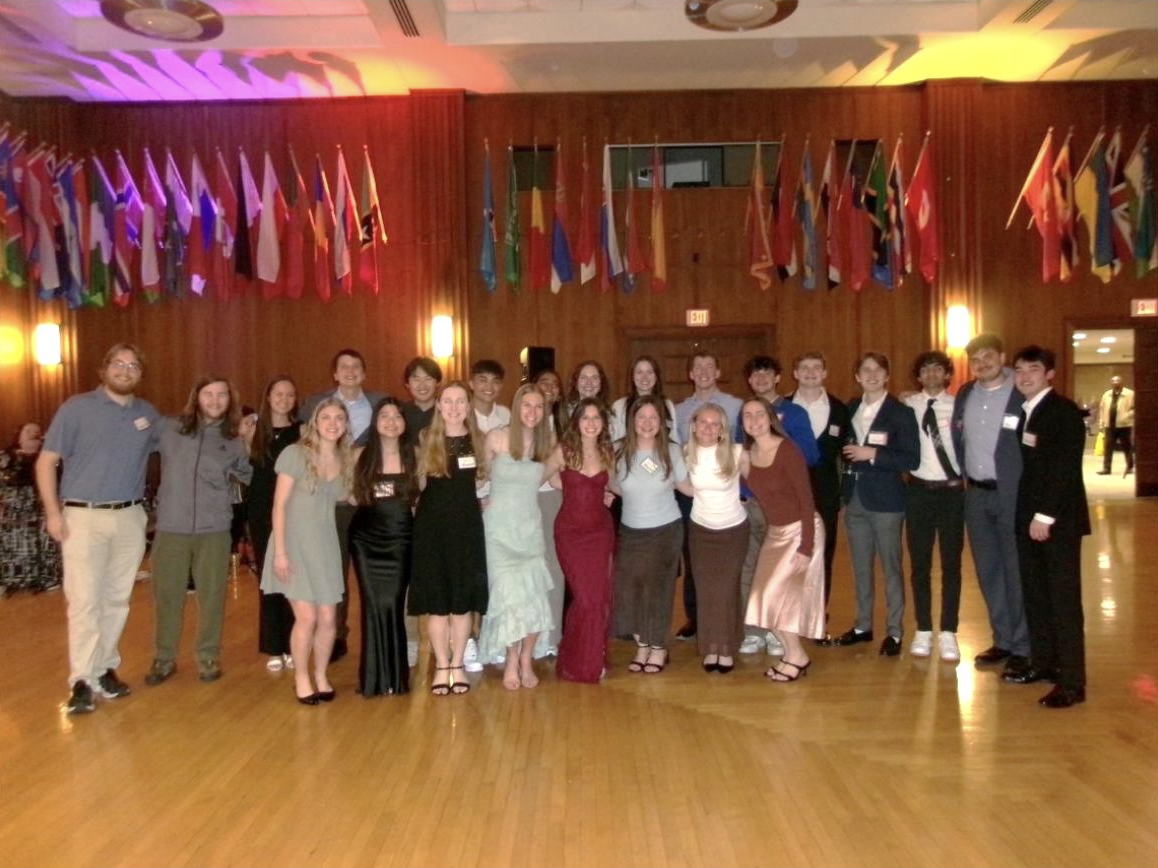
University of Iowa Students after the 100-year celebration banquet.
Friday concluded with an alumni panel in the morning, followed by a graduate student research showcase. Later in the afternoon, attendees gathered to sign the centennial banner and take a department-wide group photo, marking the culmination of a memorable celebration. As the festivities ended, the department quickly shifted gears to host the regional conference beginning that same afternoon in the Seamans Center.
The 100th anniversary celebration served as a reminder of the department’s legacy and the strong community that continues to define it. For students, it offered a unique opportunity to connect with alumni and see firsthand the many paths a CBE degree can lead to. While the department may be celebrating 100 years of history, the future of Iowa Chemical and Biochemical Engineering feels just as exciting.
Acknowledgements
Thank you to the AIChE Officers for their hard work and efforts to make our AIChE Student Chapter a successful organization!
Spring 2026 AIChE Student Chapter Officers:
President: Ashley Constantino
Vice President: Matt Kawa
Secretary: Fahim Rafi
Treasurer: Evelyn Moorhouse
Newsletter Editor: Natalie Schlichte
Webmaster: Cade Machin
Historian: Lana Prainito
Social Chair: Luke Bennett
K-12 Program Coordinators: Henry Benton, Holly Shriber, and Will Stiles
Volunteer Chair: Grant Anderson
Advisor: Professor David Murhammer
Editor-In-Chief Natalie Schlichte would also like to thank the following people for their support and contributions to the Spring 2026 AIChE Student Chapter Newsletter:
Faculty Advisor: Professor David Murhammer
Contributors: Professor David Murhammer, Spencer Dove, Ria Patel, Cade Machin, Holly Shriber, Henry Benton, and Matt Kawa
Your help is greatly appreciated!