Advisor’s Corner
Professor David Murhammer
Greetings to Hawkeye Chemical Engineers!! This Fall 2025 issue of our AIChE Student Chapter Newsletter begins with an article written by our volunteer chair Grant Anderson about the semester’s volunteer activities. The next article, written by one of our K-12 coordinators Henry Benton, discusses our chapter’s participation in the K-12 Outreach Competition at the AIChE Annual Student Conference (ASC) held in Boston, MA.
Other articles in this issue include (i) an overview of our chapter’s participation in activities at the AIChE ASC, (ii) discussion of our chapter’s plant trip to Emerson in Marshalltown, IA, and (iii) thoughts about being a student in the chemical engineering program at the University of Iowa. Highlights from the AIChE ASC include (i) our ChemE Jeopardy team lost in the semi-final round, thereby denying us of our third consecutive championship, (ii) Amy Kahler and Klaertje Hesselink received 2nd and 1st place awards, respectively, in the research poster competition, and (iii) our chapter received an Outstanding Student Chapter Award for the 21st consecutive year.
As mentioned in the Spring 2025 issue of this newsletter, the Spring 2026 semester will be especially eventful in our department with the 100-year anniversary celebration of our department being held April 9-10, 2026, and the AIChE Mid-America Regional Student Conference will follow on April 10-11. Some of you might be interested in the following table of the schools in the Mid-America region and the year that their AIChE Student Chapters were chartered. I assembled this table during the planning for the regional conference.
University | Chartered |
University of Iowa | 1924 |
Iowa State University | 1931 |
University of Missouri, Columbia | 1932 |
Washington University | 1932 |
Kansas State University | 1934 |
University of Oklahoma | 1935 |
University of Kansas | 1936 |
University of Arkansas | 1937 |
Oklahoma State University | 1938 |
University of Nebraska, Lincoln | 1938 |
Missouri University of Science and Technology | 1939 |
University of Tulsa | 1955 |
Benedictine College | 2018 |
Olivet Nazarene University | 2023 |
Any comments about the newsletter should be sent to me at david-murhammer@uiowa.edu.
Fall 2025 Volunteer Events
Grant Anderson
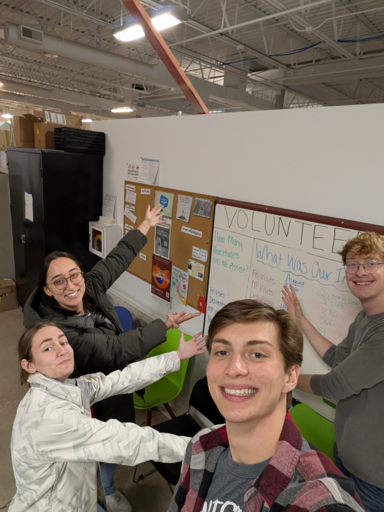
This semester, I focused on expanding the AIChE chapter’s community outreach and volunteer opportunities. I started the semester by reaching out to multiple local community organizers, as well as polling the chapter for the best dates and times to volunteer.
We began the semester by volunteering with Houses Into Homes. This organization specializes in furnishing and otherwise providing for families and individuals who are exiting homelessness, domestic violence, and other crises. AIChE has worked with this organization in the past, and they were in high demand from chapter members. When the weather improves this spring, we will likely volunteer with Houses Into Homes again.
Throughout the semester, I aimed to provide as many opportunities as possible for students to volunteer around their schedules. For these additional opportunities, we planned multiple shifts at the CommUnity Food Pantry. These were shorter, more flexible time slots that allowed most members to find a shift. This organization was very accommodating and easy to work with, and we’ll definitely be returning in the spring.
Our last volunteer event was a collaboration with a fellow student organization, Iowa City Homeless Project (ICHP). This was a phenomenally well-attended social, making tie blankets for donation. I’m so thankful to all the members of ICHP and AIChE who did most of the brainstorming and organizing to make this event possible.
Next semester, we’ll prioritize encouraging and including the new AIChE members, as well as expanding to other local organizations. I really enjoyed serving as the volunteer chair so far and I was very enthusiastically re-elected for this spring, so there’s plenty more to come!
K-12 Outreach Competition
Henry Benton
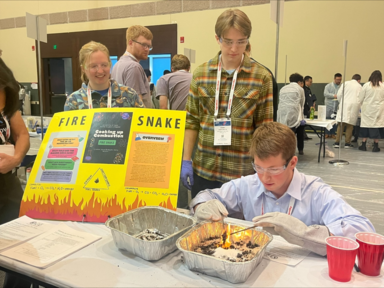
This year, Anna Blobaum, TJ Kimm, and I were fortunate to travel to Boston, Massachusetts, to compete in the AIChE K–12 STEM Outreach Competition. The competition is held annually at the AIChE Annual Student Conference and provides universities from around the world an opportunity to showcase hands-on experiments or demonstrations designed to engage students within a specific K–12 age range. More than one hundred local K–12 students were invited to attend the event and interact with the modules. At the conclusion of the showcase, judges evaluated each module and selected winners for each age group as well as an overall best module.
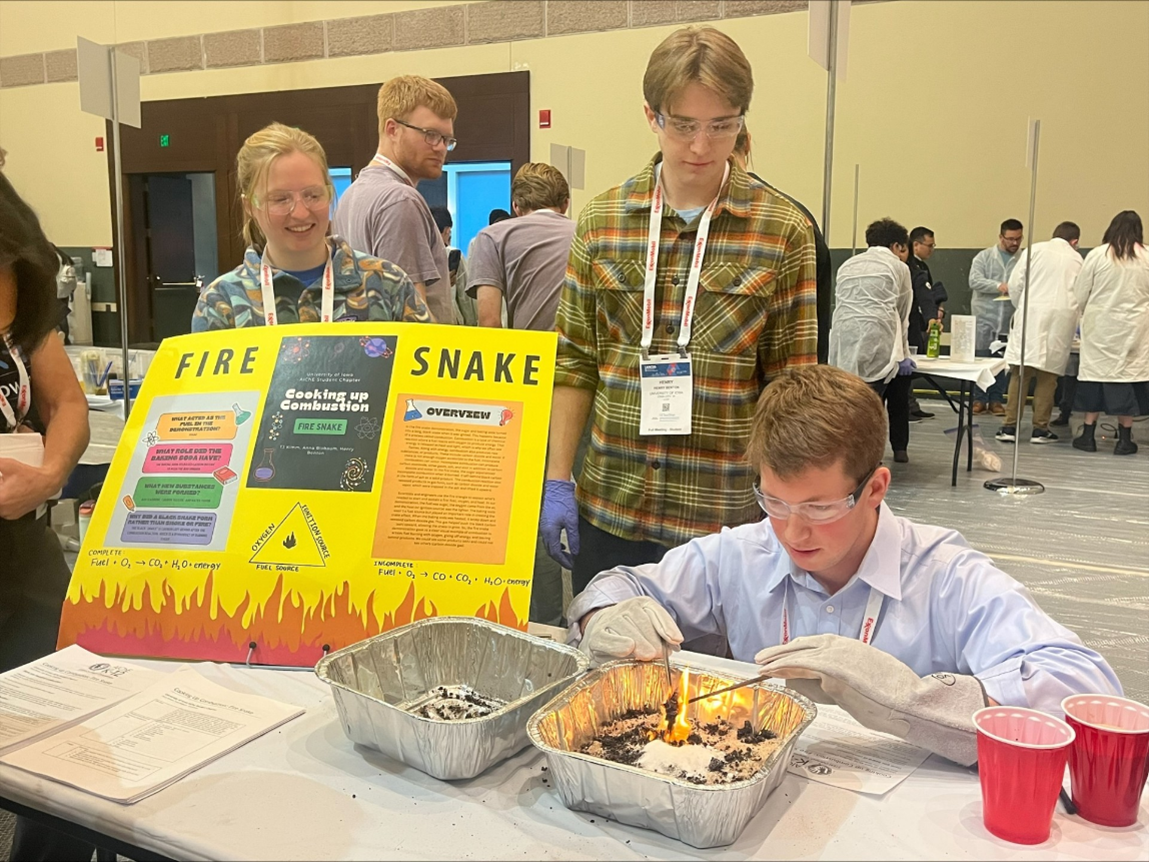
Our team presented a module titled “Cooking Up Combustion: Fire Snake,” which demonstrated a visually engaging example of a combustion reaction. By mixing sugar and baking soda and igniting the mixture, we produced a growing column of ash that climbed upward, resembling a snake. After creating the tallest snake, we reasonably could, we discussed the reaction with the students and explained how chemical engineers harness combustion reactions in real-world applications such as automobiles and electricity generation.
This module served as an effective introduction to chemical reactions for younger students by highlighting one of the most familiar reaction types: combustion. Our booth included a poster that reinforced key concepts such as the fire triangle and a basic combustion reaction scheme, which benefited greatly from visual representation. Because the demonstration involved an open flame, safety was a major priority. We implemented several precautions, including the use of fire-resistant materials, appropriate personal protective equipment, and a readily available fire extinguisher. Additionally, one team member was always stationed beside the booth to ensure the safety of both participants and observers.
Since we had never presented this module to an audience before the competition, we were initially nervous about filling the full 18-minute time slot while keeping students engaged. Although our first presentation included a few minor challenges, we were able to adjust our pacing and delivery for subsequent sessions. While fire alone can be captivating, students were particularly amazed by the steadily growing pile of ash. They asked thoughtful questions about what they were observing and made connections between the reaction and other examples of combustion they had encountered.
The K–12 Outreach Competition was an excellent opportunity to network, gain new outreach ideas, and refine our ability to present technical concepts to a younger audience. Although we did not leave the competition with any prizes, the experience was highly valuable. We look forward to applying what we learned and returning to next year’s competition in Minneapolis.
2025 AIChE Annual Student Conference
Klaertje Hesselink
Overview
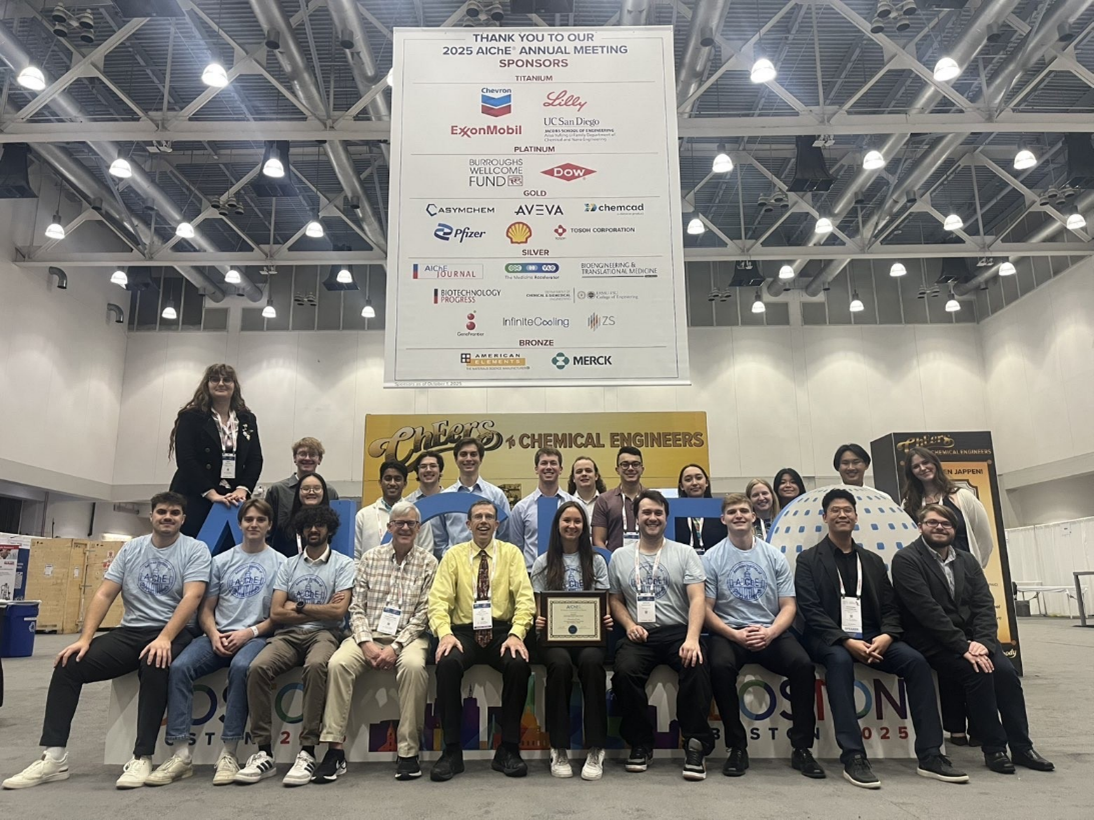
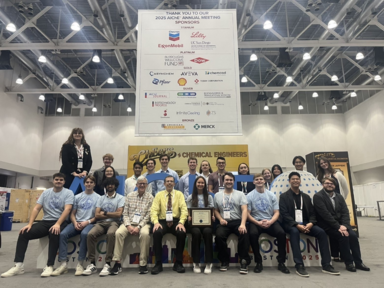
This year the Annual Student Conference for Chemical Engineers took place from October 31st–November 3rd in the John B. Hynes Veterans Memorial Convention Center in Boston, Massachusetts. A total of 21 students from the University of Iowa attended along with faculty members Prof. Murhammer, Prof. Nuxoll, and Prof. Seo.
Student Technical Presentation
On the first day of the conference, President Gabi Fiedor and Vice President Klaertje Hesselink gave a presentation at the student technical sessions on the importance of process safety in undergraduate education. Inspired by Professor Murhammer’s safety course and the Tinker safety competition, they presented on many aspects including how to design a safety competition. Building on this foundation, the presentation emphasized the need to embed process safety principles early and consistently within the undergraduate curriculum. It highlighted how a Chemical Process Safety Competition can serve as a powerful, student-centered tool to cultivate a lasting safety culture.
By incorporating elements like safety case investigations, written analyses, and a culminating poster session, the competition encourages students to think critically about real-world hazards and risk mitigation. The presentation also discussed strategies for integrating such competitions into existing coursework and student organizations, demonstrating how friendly competition can enhance engagement while remaining aligned with industry standards. This presentation drew strong attendance from Iowa students and students from other schools. A special thanks is owed to Ms. Sharon Tinker for her continued support of the Tinker Safety Competition and for her guidance in the development of this presentation.
ChemE Jeopardy
The ChemE Jeopardy competition was a highlight of the conference, featuring fast-paced questions and strong performances from teams across multiple institutions. The University of Iowa team composed of Liam Horan (Class of 2025, now at Fauske & Associates), Colin Houts (Class of 2025, currently a PhD student at the University of Minnesota), and current seniors Rhea Fisch and Eric Hou dominated much of the game. Rhea Fisch was particularly notable for her quick and confident performance in the world flags category, where she secured several key points for the team.
Despite their strong showing, the lead was not large enough to guarantee a win going into Final Jeopardy, making the final question decisive. The last question focused on enzyme inhibition and kinetics and dependent on distinguishing between noncompetitive and uncompetitive inhibition. An incorrect response proved costly, shifting the outcome of the match. Ultimately, Notre Dame claimed first place in this round, with BYU/Utah finishing close behind, bringing an end to the University of Iowa’s winning streak in ChemE Jeopardy.
Poster Presentation
On the last day of the conference, four students presented their research in the undergraduate student poster competition. Matthew Kawa and Rhea Fisch presented in the Food, Pharmaceutical, and Biotechnology Division, Amy Kahler in the Environmental Science and Engineering Division, and Klaertje Hesselink in the Catalysis and Reaction Engineering Division. Amy Kahler won a second place for her poster on “Analyzing Drinking Water from Iowans’ Private Wells Along the Mississippi River for PFAS” and Klaertje Hesselink won first place for her poster on “Designing Catalysts for Magnetic Induction Driven Reactive Carbon Capture.”
Chapter and Student Awards
For the 21st consecutive year, our chapter was awarded the Outstanding Student Chapter Award which was received by Presidents Gabi Fiedor (Spring and Fall 2025) and Liam Horan (Fall 2024). Additionally, current junior Cade Machin was awarded the Donald F. Othmer Second Year Student Academic Excellence Award which is presented to one active AIChE undergraduate student who has attained the highest scholastic grade-point average during their first and second years. Congratulations Cade on this accomplishment!
Conclusion
Overall, the National AIChE conference was very successful and rewarding experience for all who attended. The strong student participation, competitive performances, and multiple recognitions reflect the chapter’s continued commitment to advancing chemical engineering. Attending this conference would not be possible without the support of the Department of Chemical and Biochemical Engineering.
Emerson Plant Tour
Natalie Schlichte
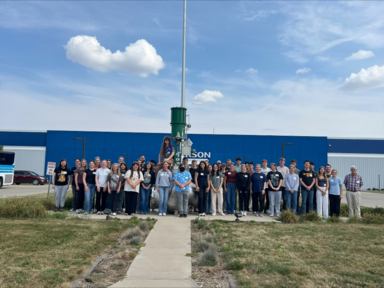
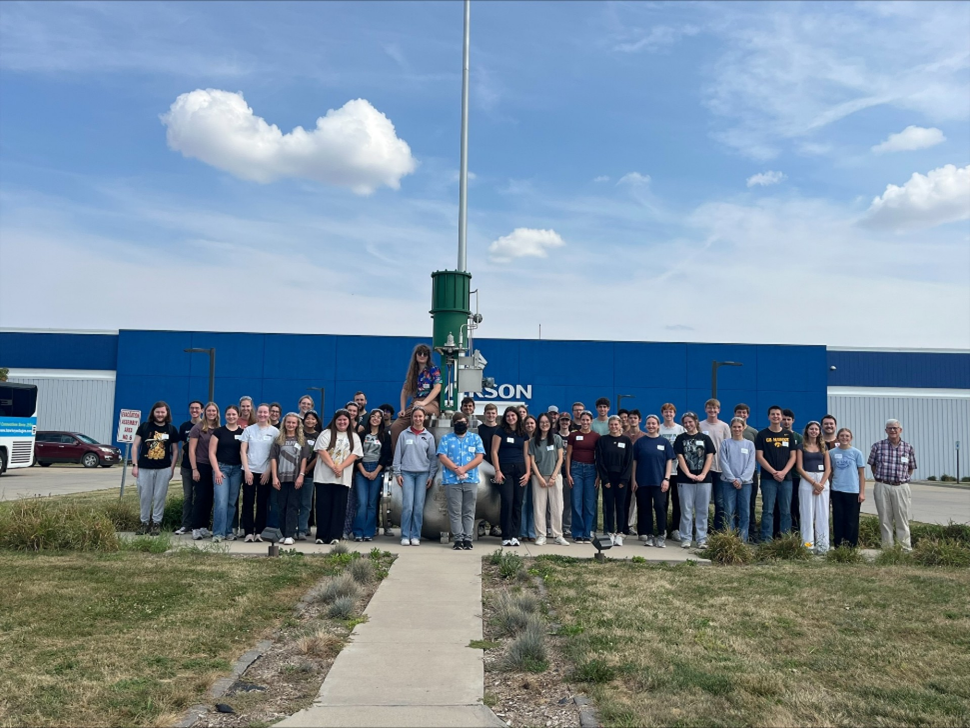
Many University of Iowa chemical engineering students had the amazing opportunity to visit Marshalltown, Iowa to tour Emerson. We started the day with a short presentation about the company. We learned that Emerson manufactures products for Fisher Controls. They specialize heavily in making control valves. After the presentation, we got to tour the plant, and we had to wear safety glasses and ear plugs. It was a great opportunity to see the various production lines. One of the most interesting things was the many different sizes of the valves they were making! After the tour, we ate lunch while a few of the engineers hosted a panel. It was cool to hear how long some of the people have been working at Emerson, and how much they seem to enjoy it there. There were also a lot of University of Iowa alumni! After lunch, we got to tour their other facility as well. For this tour, we all had to wear headphones to hear the tour guide, since the plant was so loud. It was amazing to see the amount of equipment Emerson had at this facility. The tour through the plant was a half mile loop! Overall, it was an amazing experience for the students who attended. We also got to keep our very own control valve handbook, and a “stress-relief valve”, which was a toy model of one of their control valves made into a stress ball, and an okay pun.
A Treatise on the Liminality of UIowa ChemE
Rhea Fisch
I suppose this essay defies the expectations of what a newsletter is. It’s not news, because if it were, it’d have to be new; that’s where the word comes from. What I’m writing about here has been a prevalent theme for as long as this department has had its current structure, and likely further back, as structures are evolved rather than built. This will be my last newsletter (unless Natalie asks me to write something for next semester), and this and my impending graduation have left a nostalgic shadow on my work on this newsletter. Since the audience for this newsletter is primarily alumni, I imagine the light in which you see this department is of the same wavelength, or at the very least tinted its color.
AIChE is inexorably linked with the seminar class which requires its membership. This requirement is repeated threefold from the winter of students’ sophomore to senior years. These two years reflect growing into one’s own as a chemical engineer; at the beginning being wide-eyed and excited by the simplicity of an energy balance and culminating in the catharsis of bringing everything together to design a plant, with two years of tears and tribulations in between.
Furthermore, the social landscape of the department changes in that time. Before the seminar, everyone is comparatively anonymous due to lack of familiarity, while after, everyone is comparatively distant due to lack of shared classes. The first semester of the seminar, you feel like the next generation, to be brought up to the status of protagonists alongside the current ones. You share the spotlight for a semester, and then your successors feel the same thing, you share the spotlight with them, and leave.
My sophomore year, when entering the fold of this social ecosystem, I was puzzled by the senior class. It wasn’t that they seemed so much more adult than I was, although they were four years older than me, it was that they seemed tied to each other, like they had healed each other’s scars with the same roll of bandage. I expected to watch as the same inevitably happened to me and my peers, and it did, but underwhelmingly. It’s a microcosm of becoming an adult; that’s it? I waited so long to reach this myself, and it’s still unsatisfying. This isn’t to devalue the friendships I have made; I love and cherish many of the chemes I met here, and I do have relationships with almost all of them. I noted someone as an outlier because I didn’t recognize their voice. I’m undeniably close with these people, but it feels different on the inside.
On the macro scale, this department changes glacially; professors retire or are hired every few years, causing little change to the social dynamics unless a professor is particularly beloved or infamous, and the classes change order or name on occasion (RIP Process Calc), again doing nothing but changing the slang terms by which students call their classes. The seniors are a knot, the juniors a tumbleweed, and the sophomores a jumprope absentmindedly tossed on the sidewalk. But when you analyze these social structures in this way, it fails to recognize that two years of forty people’s lives are intertwined into a web of confusing relationships with one hundred twenty other people, which are transient as students come and go, with each cohort crosslinked with their successors and priors. So no, to you, as an audience reading this on an overly sterile university website designed to keep a particular image of the department as a static institution, this isn’t covering anything new. To those of us who are the institution, these are our feelings, which when you move into a new phase of your life, are necessarily new.
Acknowledgements
Thank you to the AIChE Officers for their hard work and contributing efforts to make our AIChE Student Chapter a successful organization!
President: Gabi Fiedor
Vice President: Klaertje Hesselink
Secretary: Matt Kawa
Treasurer: Ashley Constantino
Newsletter Editor: Rhea Fisch
Webmaster: Isabella Warner
Historian: Anne Wu
Social Chair: Isabelle Pfeiffer
K-12 Program Coordinators: Anna Blobaum, TJ Kimm, and Henry Benton
Volunteer Chair: Grant Anderson
Advisor: Professor David Murhammer
Editor-In-Chief Rhea Fisch would also like to thank the following people for their support and contributions to the Spring 2025 AIChE Student Chapter Newsletter:
Faculty Advisor: Professor David Murhammer
Contributors: Professor David Murhammer, Grant Anderson, Henry Benton, Klaertje Hesselink, Natalie Schlichte, and Rhea Fisch
Your help is much appreciated!